Investigating in-space manufacturing for deep-space exploration
1
A significant challenge in deep space exploration is the scarcity of materials. Over time and in emergencies, astronauts will need the ability to create reliable parts from recycled and other available materials.
The solutions to these limitations are being developed by UIC engineers, who are leveraging creativity and advancing technologies to ensure safer, more efficient space exploration.
Leading the way are CME Professor Didem Ozevin and MIE Professor Yayue Pan at the NASA MIRO Center for In-Space Manufacturing (CISM-R2): Recycling and Regolith Processing, where they specialize in advancing In-Space Manufacturing (ISM) techniques for recycling and regolith utilization. Their research is supported by a new NASA grant.
“In-space manufacturing will be essential for long-duration missions because carrying every needed replacement part from Earth is costly and impractical,” Ozevin said. “Recycling materials in space could provide a sustainable source of feedstock, but repeated recycling can change viscosity, glass-transition temperature, and other properties that affect printability and part quality.”
She will be leading the development of an ultrasonic system to measure these changes during filament production and 3D printing. The real-time information could reduce material waste, shorten process-optimization time, and improve the reliability of parts manufactured in space.
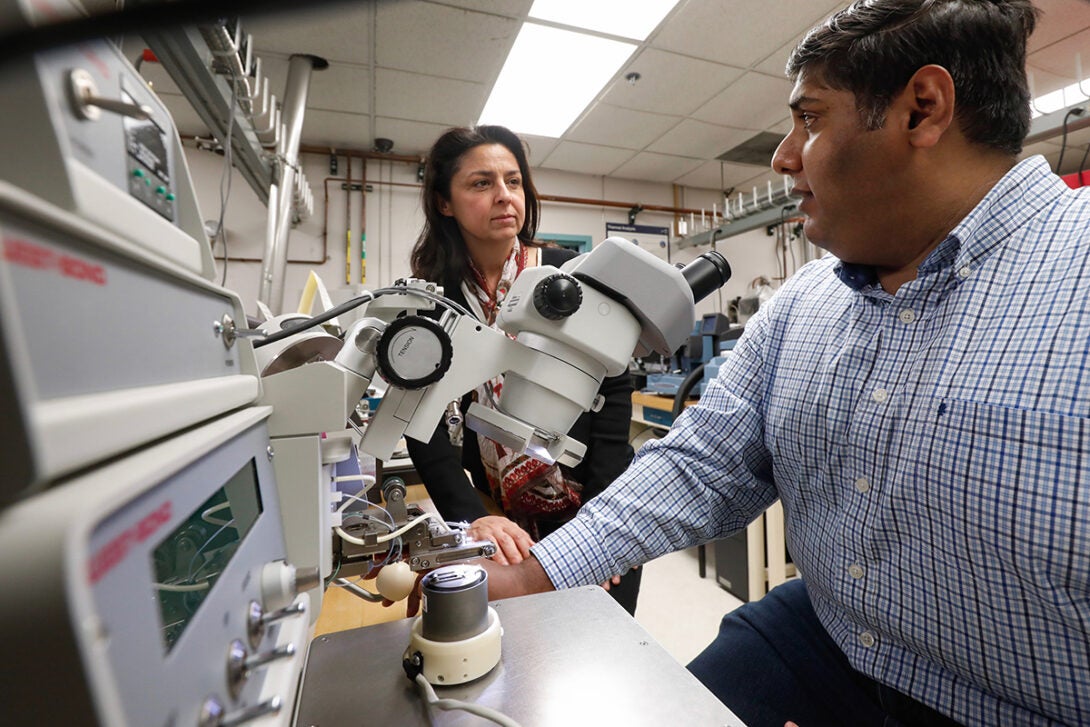
“My research group will investigate how guided ultrasonic waves respond to changes in the thermal and rheological properties of recycled materials. We will also integrate the sensors into filament-production equipment and fused deposition modeling printers to enable real-time monitoring under harsh operating conditions at the NASA Marshall Space Flight Center,” said Ozevin, director of the Nondestructive Evaluation Laboratory at UIC.
This problem cannot be solved through a single discipline. It will require the knowledge of polymer science, rheology, additive manufacturing, sensors, ultrasonics, and data analysis.
To find a solution, Ozevin and Pan will combine their complementary expertise in material behavior.
“Dr. Pan’s team will help integrate sensors to 3D printers and characterize how recycled materials change during repeated processing, while my team will develop ultrasonic measurements that can detect those changes in situ,” Ozevin said. “These sensors are designed to keep working in extreme temperatures, radiation, and the vacuum of space.”
The research will also impact UIC engineering students, who will gain interdisciplinary, hands-on experience at the intersection of advanced materials, sensing technologies, additive manufacturing, and space exploration.
“They will work with sensors, ultrasonic measurements, recycled polymers, rheological testing, and 3D-printing systems. Students will also learn how researchers from different fields collaborate to address a complex engineering problem,” Ozevin said.